
How to Get Court Records
Indiana MyCase comes first. Pull up the Jefferson County case and open the Chronological Case Summary. Find the event you care about. A document icon sometimes opens a public filing. Even without a link, the paper may still sit in the official file. When you must order from the Clerk, Indiana's court-record request guidance points to one place. Contact the Clerk where the case was heard. Jot down the cause number, the court, and the case style first. Add the document description, its filing or order date, and the format you want. Then pick the right channel.
- Check MyCase for a public event and linked document.
- Call the Clerk at the county-published 812-265-8922 and verify access, fee, format, payment, and timing.
- For counter service, visit Room 203 at 300 East Main Street, Madison, Indiana 47250, during 8:00 a.m. to 4:00 p.m.
- Before using mail or fax, ask what request format and payment method the Clerk accepts.
- Send transcript requests to the court reporter and bulk-data requests to OJA.
The county lists fax 812-273-5428 as well. It publishes no general court-copy form or mail template, no drop box, and no stated turnaround. A second number, 812-265-8924, appears in the state directory. Confirm that one before you rely on it.
Three Jefferson Record Layers
Think of Jefferson records in three layers. A Case Summary is only an index. Behind each event sits a filed document, the actual item. A certified copy is different again: the Clerk authenticates the reproduction. Each layer serves a distinct need. None can stand in for another.
- Case Summary
- Public event history with dates, status, settings, and selected fields.
- Filed document
- A complaint, petition, answer, motion, order, judgment, transcript, exhibit, or other item in the file.
- Certified copy
- A copy authenticated by the Jefferson County Clerk for an official recipient.
- Transcript
- A written record prepared through the court reporter, with separate rates and procedures.
A copy you print or save as an image does not count as certified on its own. Check with the office or person receiving it before you pay the copy fee.
Types of Court Records
The Jefferson County Clerk keeps files for both Circuit and Superior matters, covering criminal, civil, family, probate, juvenile, small-claims, eviction, infraction, and traffic cases. What is public varies case by case and document by document. MyCase help notes that some civil orders, certain nonconfidential criminal documents, final criminal orders or judgments, expungement materials, and appellate records may be linked. Coverage is not uniform.
Other offices sell different products. A reporter supplies a transcript. The Office of Judicial Administration rules on state bulk-data requests. BMV holds your driving record. For case events and filed documents, the Clerk's court file is still the source.
Room 203 and Older Files
Room 203 serves as the court-record counter. It serves both trial courts. It is the practical fallback for older records. It also handles missing scans, plain copies, certified copies, and questions about the official file. The county confirms no public terminal, so do not count on self-service access in person.
Clerk of Circuit and Superior Courts
Room 203
Jefferson County Courthouse
300 East Main Street
Madison, IN 47250
812-265-8922
Hours: 8:00 a.m. to 4:00 p.m.
Security screens everyone entering the courthouse. Know the difference, too, between an archive request and a general court-copy request. Bring the case number and document date with you. Staff cannot be expected to guess which file you need.
What a Court Record Contains
A complete file can hold material that never appears as a public image. The docket event helps you name the document. The Clerk then decides what public copy can be supplied.
| Case header | Cause number, court, case type, filing date, status, and judicial officer |
|---|---|
| Pleadings | Complaint, petition, answer, charging paper, or other initiating and responsive filings |
| Motions and orders | Requests for court action and the resulting judicial directions |
| Settings | Hearing date, time, type, location, officer, and later reset events |
| Disposition | Judgment, dismissal, plea, sentence, or other final action as applicable |
| Attachments | Exhibits or supporting material, subject to exclusion, seal, and retention rules |
Not every filing attached to a public Jefferson County court record is public itself. Medical and treatment records, privileged material, juvenile files, and details that identify victims, witnesses, or private individuals can be withheld or blacked out.
Indiana Access Rules Online
The Indiana Access to Court Records index gathers every governing rule in one place.
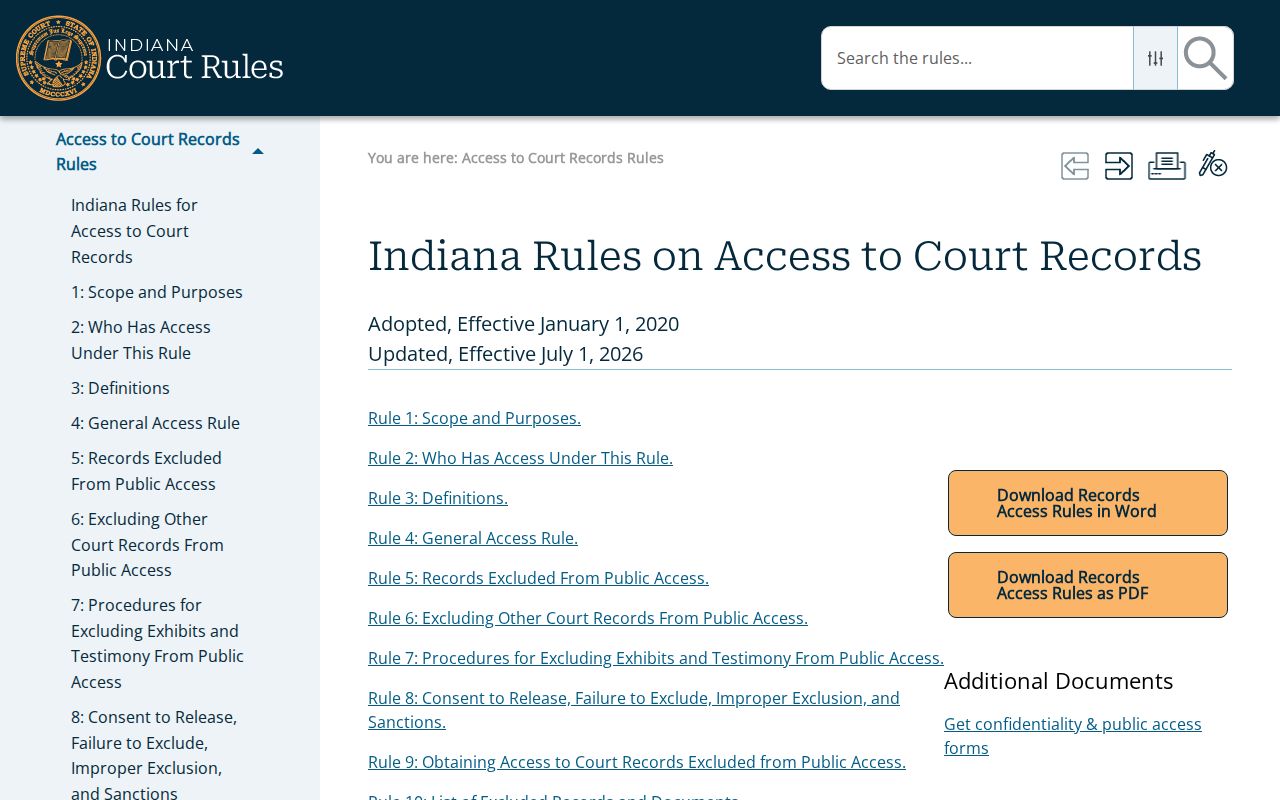
What controls a record's public status is the current rules, not the mere presence of a MyCase event. Rule 4 sets the general accessibility baseline.
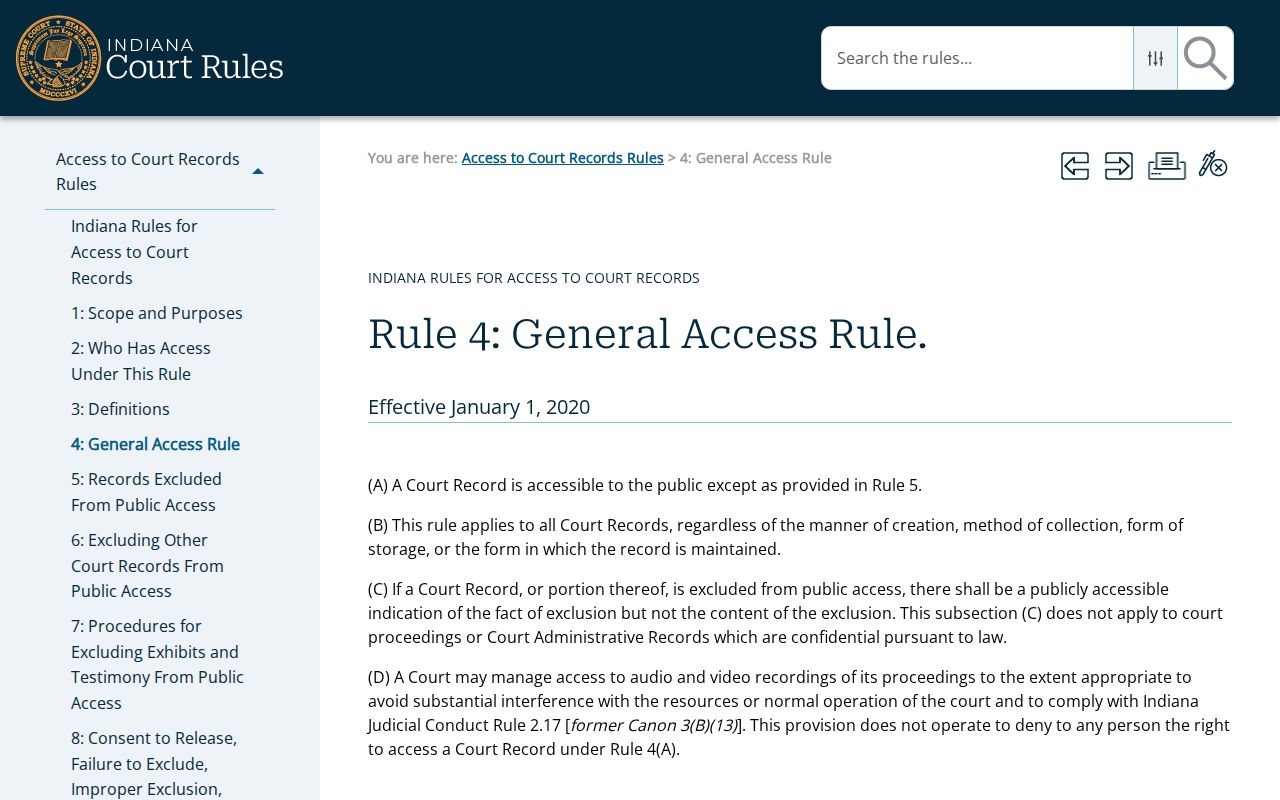
It applies to paper, electronic, audio, and other court-record forms unless an exclusion governs.
Certified Copies and Fees
Jefferson's current plain-copy, certified-copy, and search fees are not published. Ask the Clerk for the amount, the authentication supplied, accepted payment, delivery, and expected turnaround. Do not quote a Recorder fee or a civil filing charge in its place.
| Product | Located amount | Limit |
|---|---|---|
| Archive paper copy | $1 per page | Archive or genealogy context; verify use for a court file |
| Archive digital copy | Free by email | Archive context only |
| Certified court copy | Not published | Ask Clerk |
| Plain court-file copy | Not published | Ask Clerk |
| Transcript | $5 per page base | Court reporter, separate local rule |
| OJA one-time processing | $88 per hour | State bulk data, not an individual copy |
The transcript rule does publish rates. A transcript or exhibit-volume copy runs $2.50 per page. Expedited work maxes out at $8 per page within 24 hours, or $6.50 within three working days. Jobs of ten pages or fewer carry a $50 minimum, and assembly costs $22 per hour.
Transcripts Use Another Custodian
A transcript is not a Clerk counter copy. State guidance sends it to the court reporter instead. Name the Jefferson court, the cause number, the hearing date, and the reporter when you know it. Reporter rates come from local rule LR39-AR-15-AD-6, separate from the Clerk's copy charges.
OJA's monthly file-drop rates belong to the bulk program. They run $0.01 for a closed case and $0.10 for an open or new case. Messaging rates apply too. They say nothing about the cost of one certified Jefferson County record.
Public Access and Sealed Records
Rule 5 identifies whole cases and individual records excluded from public access.
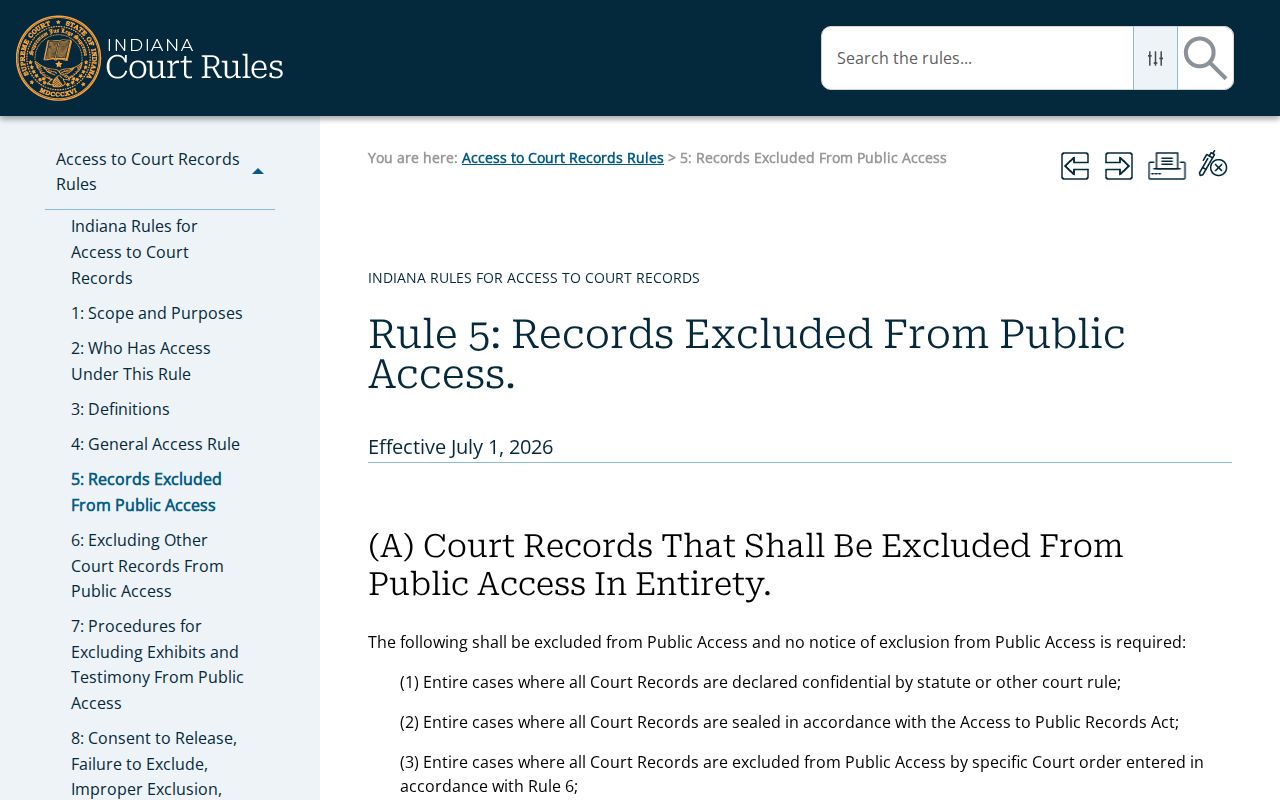
It covers confidential-by-law records plus categories like juvenile, mental-health, treatment, privileged, and protected identifying information.
Indiana Code 5-14-3 supplies the general public-record framework, but APRA does not override an Indiana court-record exclusion or sealing order.
If an ordinary public-record request is denied or delayed, the Indiana Public Access Counselor can discuss it. Access to an excluded court record instead follows the court rules. The legal basis matters.
Rule 9 Extraordinary Access
Rule 9 opens a door in three ways: waiver, court declaration, or a verified written request. The written request must show extraordinary circumstances and a public interest. It must avoid significant harm or prejudice. While the request is considered, the record stays confidential. Notice and a chance to respond are built into the process. The current extraordinary-access rule spells out the exact procedure.
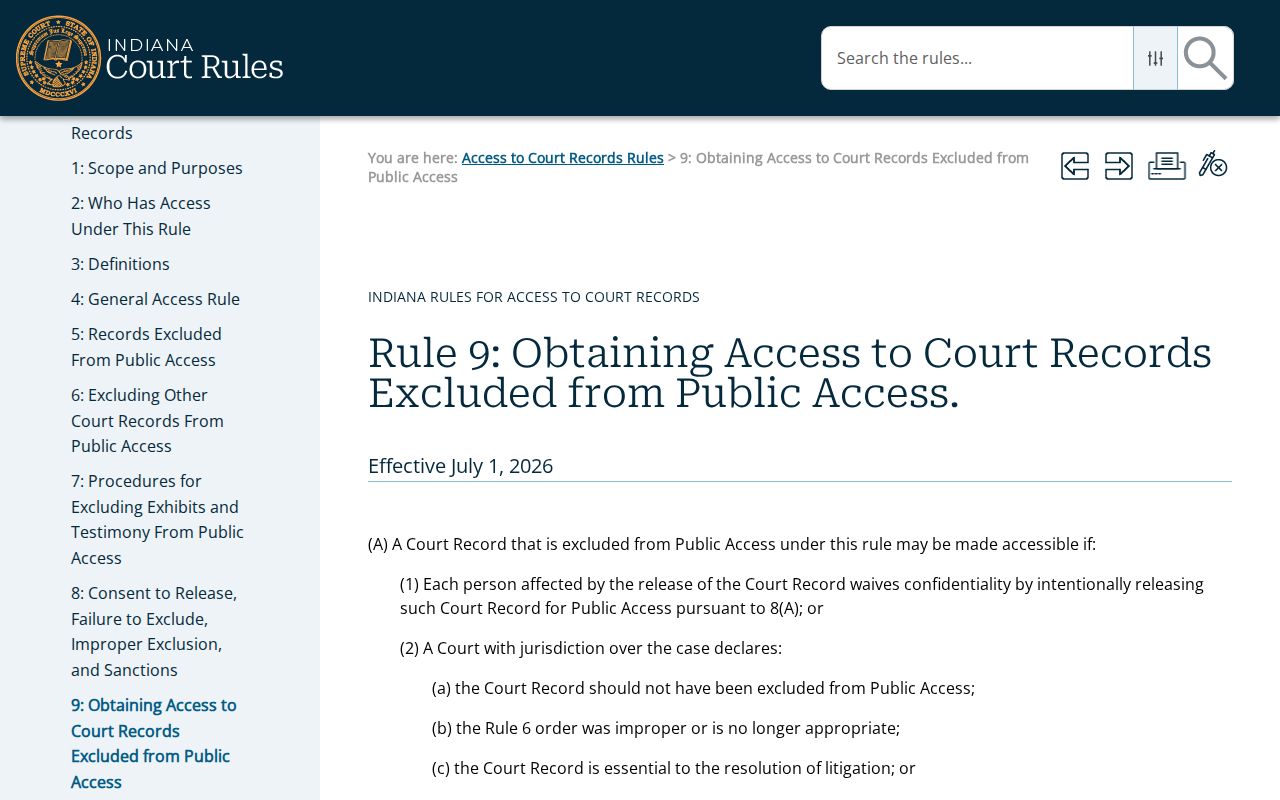
Rule 9 is no promise of disclosure. The Jefferson court decides on the verified request and the governing law.
Jefferson Court Records After 2009
Fire hit the Jefferson County Courthouse in 2009. The official court-history account notes water damage to records and temporary court operations while the building was restored. So an old file usually runs through the Clerk and the archives. That history does not prove any named case was destroyed, though. For a Jefferson County court record that old, give the Clerk the cause number if you know it. Add names and a date range. Include the court and the document type. Then ask whether a paper copy, an archive copy, or a scanned public copy survives.
The Clerk's archives run deep. Wills, marriage licenses, and most other courthouse documents date back to 1811, according to the Form Center. The genealogy form there asks for applicant and ancestor details, a ten-year date frame, and the record type you want. It is not a general docket-copy form. A court case file needs a different request.
Specify the Jefferson Court Record
A narrow request works better than a broad one. State the cause number, the court, the filing or hearing date, the document name, and the format you want. Ask if the file is public. Also ask whether it sits in current storage or the archive. Indiana's public-record framework expects that kind of particularity. No agency has to build a new record just to answer a question.
If the answer is a denial, ask for the legal basis. A Rule 5 exclusion, a sealing order, and a missing archive image are three different problems. Each one has a different fix. The Indiana Public Access Counselor handles APRA process questions. APRA still cannot override a court's own confidentiality rules.
Indiana Record Request Routing
The official Indiana court-record request page splits its guidance by record type. It covers local case files, transcripts, and state administrative records, each with its own request route.
That routing confirms the split. A Jefferson trial-court file starts with the local Clerk, while a transcript starts with the court reporter.